
In this article
Local to whom?
“Local, friendly service” sounds welcoming until you realise the website never says where local is. A customer may have arrived from a recommendation, a search result or a link passed on in a message. They do not necessarily know where your business is based.
Make your core working area easy to find. A short sentence near your service description often does more useful work than a decorative map at the bottom of the page. It helps suitable customers get in touch and gives others a chance to check before writing a long account of a job you cannot reach.
Describe three sensible levels of coverage
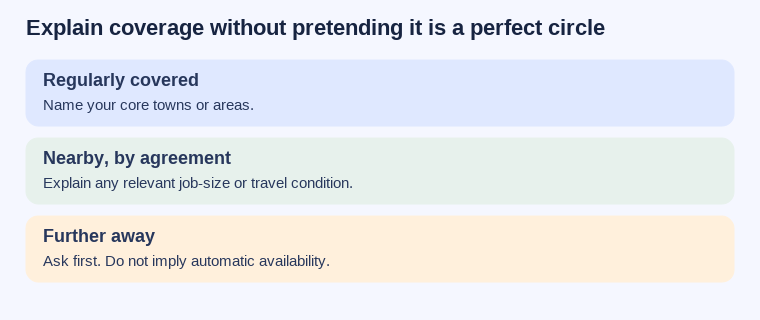
Think about the area you routinely cover, nearby places you may consider and work that needs a separate conversation. Your actual boundaries may depend on the size of the job, travel time or the kind of service. It is fine to explain that instead of pretending every enquiry fits a perfect circle.
Do not turn an occasional long-distance project into a permanent claim that you cover half the country. Equally, do not make your wording so narrow that a customer just outside the main area assumes there is no point asking. A clear core area plus an honest qualification is usually easier to understand.
- Core area: places you normally serve for the work described.
- Nearby area: places you may cover, with any relevant condition.
- Further away: ask first; do not imply automatic availability.
Use place names customers recognise
You may organise the day by postcode, but a customer may think in towns, neighbourhoods or nearby landmarks. Start with familiar place names and add postcode information only where it makes the boundary clearer. Avoid a huge block of place names that nobody wants to read.
If two places share a name, include enough context to distinguish them. If you serve part of a large city, say which part. A business address is not a complete explanation of coverage: somebody can see where you are based and still be unsure whether you will travel to their job.
Be clear when different jobs have different limits
A small repair and a week-long installation may justify different journeys. If that is how your business works, describe it in simple terms. “For larger fitted furniture projects, I may travel beyond my usual area—please ask” is more useful than an unexplained asterisk.
Where travel charges or minimum job sizes affect the decision, discuss them early enough for the customer to make an informed choice. Do not bury an important condition in wording that suggests universal coverage. Your service-area paragraph should help start the right conversation, not create an expectation you have to undo later.
Service-area wording starter
Based in [place], covering [core towns or areas] for [main type of work].
For [relevant project type] in nearby areas, please ask before making arrangements.
Send your [town or postcode area] with your enquiry so I can confirm whether I can help.
Use a map only if it answers something
A map can be useful when a boundary is easier to show than describe. It should agree with the written coverage and remain understandable on a phone. An unexplained pin merely shows a location; it does not tell a customer whether the business will visit them.
You do not need to publish a private home location to explain a service area. Decide what location information is appropriate for your business and check any separate requirements that apply to your setup. Keep the practical coverage statement clear regardless of whether you include a map.
Make the answer consistent across the website
Check the homepage, contact page, service pages and any enquiry form. If one says “Sheffield and nearby areas” and another suggests nationwide work, the customer has to guess which is current. Update older project captions only where they misleadingly imply present-day coverage; a genuine past job can remain a past job.
Finally, ask someone unfamiliar with the business where they think you work. If they can answer without hunting through the footer, you have probably made the important improvement. The goal is a clear expectation, not a longer list of locations.
YOUR NEXT ACTION
One useful thing to do
Write one coverage sentence naming your core area and explaining when a nearby customer should ask first.
Prepared with AI assistance for My Next Action. Examples and illustrations are explanatory; they do not represent customer projects or testimonials.